
Hong Kong: Top Trends for Q4 2026
Hong Kong employment in 2026 at a glance
Hong Kong’s labour market has shifted decisively into a cautious, cost-aware phase in 2026. Employers are spending more time optimising the workforce they already have, reshaping benefits, and building AI capability, rather than chasing headcount growth. At the same time, several structural changes to how people are paid, protected, and attracted to Hong Kong are reshaping employer obligations.
Here is the short version for finance directors, HR leaders and international businesses running or expanding a Hong Kong entity:
-
Hiring intent is
-
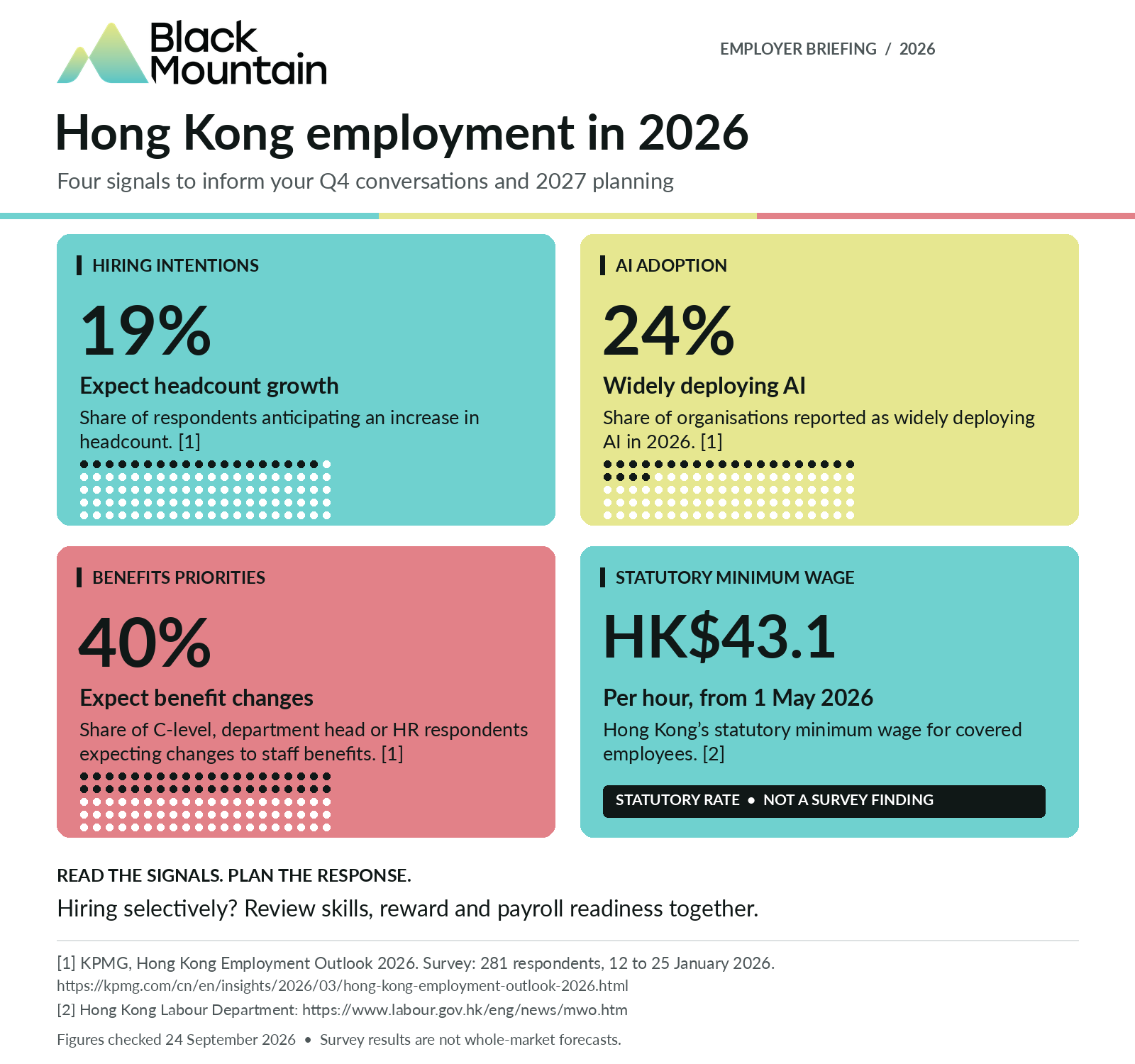
at its most conservative in recent years, with only 19% of employers expecting to grow headcount and 22% expecting decreases, according to KPMG’s Hong Kong Employment Outlook 2026.
-
The statutory minimum wage rose to HK$43.1 per hour from 1 May 2026, alongside a new annual review formula (Labour Department).
-
The MPF offsetting arrangement was abolished on 1 May 2025, and the associated 25-year employer subsidy scheme is now in its second year (Labour Department Subsidy Scheme).
-
AI has moved from pilot to production for a growing share of Hong Kong employers, tripling year on year to 24% of organisations deploying it widely (KPMG).
-
Talent-attraction schemes remain a strategic lever, with the Top Talent Pass Scheme still offering an initial 24 to 36 month stay for high-income earners and top-university graduates (Immigration Department).
The pattern for the remainder of the year is clear. Boards want tighter control over people costs, sharper productivity, and confident compliance, without losing access to the specialist talent that Hong Kong relies on. Q4 is where those priorities get tested.
A cautious hiring market with a sharper focus on revenue roles
The most striking feature of the 2026 Hong Kong Employment market is not layoffs. It is restraint. KPMG’s 2026 outlook shows only 19% of employers expect headcount to grow, the lowest reading in recent years, while 22% expect it to shrink. Hiring, where it is happening, is concentrated in sales and other revenue-generating roles, reflecting a very deliberate focus on top-line performance.
Two things follow for employers preparing Q4 workforce plans:
-
Every hire has to defend itself commercially. The bar for approvals has risen. Job specifications, business cases and role scoping need to make the revenue or margin case explicit, not just describe a workload.
-
Retention has quietly become a bigger lever than acquisition. KPMG reports 21% of employees are considering a career change in 2026, down from 28% the year before, and 63% of those who stayed with their employer received a salary increment. Employees are in a “wait and see” mood, which gives well-run employers a genuine opportunity to reinforce the reasons to stay.
For international businesses running a Hong Kong entity, the practical implication is that Q4 is the right time to review compensation ranges, benefits utilisation and role design, before annual reviews and 2027 planning cycles collide in January.
MPF offsetting: employers are now living with the reform
The abolition of the MPF offsetting arrangement was one of the most significant employment law reforms in a generation. From 1 May 2025, employers can no longer offset severance payments and long service payments against MPF benefits derived from their mandatory contributions, which changes the true cost of ending employment (Labour Department Subsidy Scheme).
Two features of the reform matter most for Q4 2026 planning:
-
The government’s 25-year Subsidy Scheme is designed to share affected employers’ severance and long-service payment costs for the employment period on or after 1 May 2025. It is applied against a HK$500,000 threshold, with employer subsidy ratios stepping down progressively over the 25-year window (Labour Department Subsidy Scheme).
-
Applications are made through the government’s TransitionEase platform, or by traditional submission channels to the Service Centre for the Subsidy Scheme (Labour Department Subsidy Scheme).
What employers should be doing now:
-
Reconcile the way severance and long service payment exposures are provisioned in the ledger, so that pre- and post-1 May 2025 service periods are treated separately.
-
Confirm that payroll and HR systems flag employees whose service crosses the transition date, and that termination workflows produce the calculations the subsidy application needs.
-
Build the subsidy claim into the standard termination process, rather than treating it as an ad hoc exercise per case.
This is one of the areas where a specialist Hong Kong payroll partner earns its fee quickly. The mechanics of the subsidy scheme are workable, but they are unforgiving of missing documentation.
Minimum wage and the new annual review formula
The Statutory Minimum Wage rose to HK$43.1 per hour from 1 May 2026, and the monthly monetary cap on the requirement for employers to record total hours worked was raised to HK$17,600 per month (Labour Department).
Two points are easy to miss:
-
The Government has moved to an annual review formula for the SMW, replacing the previous biennial cycle (Labour Department). Employers should expect a rate change to be a recurring feature of their spring payroll calendar.
-
The HK$17,600 hours-recording threshold matters even for salaried workforces. Where cash wages in a month exceed the threshold, employers are relieved of the statutory obligation to record the total hours worked, but the threshold is a moving target and should be checked each year.
For Q4, the practical action is a clean audit of the lowest-paid roles against the new rate, and a check that any timekeeping or overtime processes still hold up under the current threshold.
Attracting talent: TTPS and the specialist skills gap
Hong Kong’s talent attraction schemes remain a core part of the employer toolkit, and the Top Talent Pass Scheme (TTPS) is still the most flexible option for international hires. Under the current rules, Category A (high-income) applicants receive an initial 36-month stay, while Category B and Category C applicants receive 24 months (Immigration Department).
Two features are worth reinforcing when advising international candidates:
-
No prior job offer is required to apply, which makes TTPS particularly useful for hard-to-fill roles where the employer wants a shortlist of candidates ready to start (Immigration Department).
-
Category A requires annual individual income of HK$2.5 million or above in the year immediately preceding the application, from employment or self-owned companies (Immigration Department). Investment income does not count.
KPMG reports that Hong Kong organisations are strategically seeking overseas talent to close skill gaps, particularly in sales and marketing, technology and IT, operations and supply chain, and R&D. Employers who want to use the schemes well should treat visa strategy as part of the workforce plan, not an afterthought raised once an offer is signed.
Benefits, flexibility and the retention question
KPMG also finds that 40% of respondents at C-level, department head or HR level expect their organisations to change the benefits offered to staff in 2026, and nearly a third plan to enhance or rebalance benefits, primarily in response to rising medical costs.
Underneath the headline number, the story is about employee expectations. Since 2023, the top three drivers for employees considering a move have been compensation, career progression and work flexibility (KPMG). The non-monetary top three for staying are work flexibility, career progression and job satisfaction. Junior staff increasingly prioritise a convenient work location alongside those factors.
For employers, this points to a specific Q4 exercise:
-
Benchmark the medical and family-support parts of the benefits package against the rising cost of care.
-
Audit the flexibility offer, not just the policy on paper, but how consistently managers apply it.
-
Make career progression legible. Employees who cannot see the next step are more likely to look outside for it.
What our clients say
“We have partnered with Black Mountain HK for nearly a decade. The payroll contacts assigned to us, Tracy Chou and Louisa Cheung, bring deep expertise and consistently deliver reliable, high-quality work. What sets them apart is their proactive approach — offering thoughtful advice and sharing best practices that help us stay ahead. It feels less like working with a vendor and more like having trusted colleagues who genuinely care about our success.”
— Herwani, Schroders
A practical Q4 2026 checklist for employers in Hong Kong
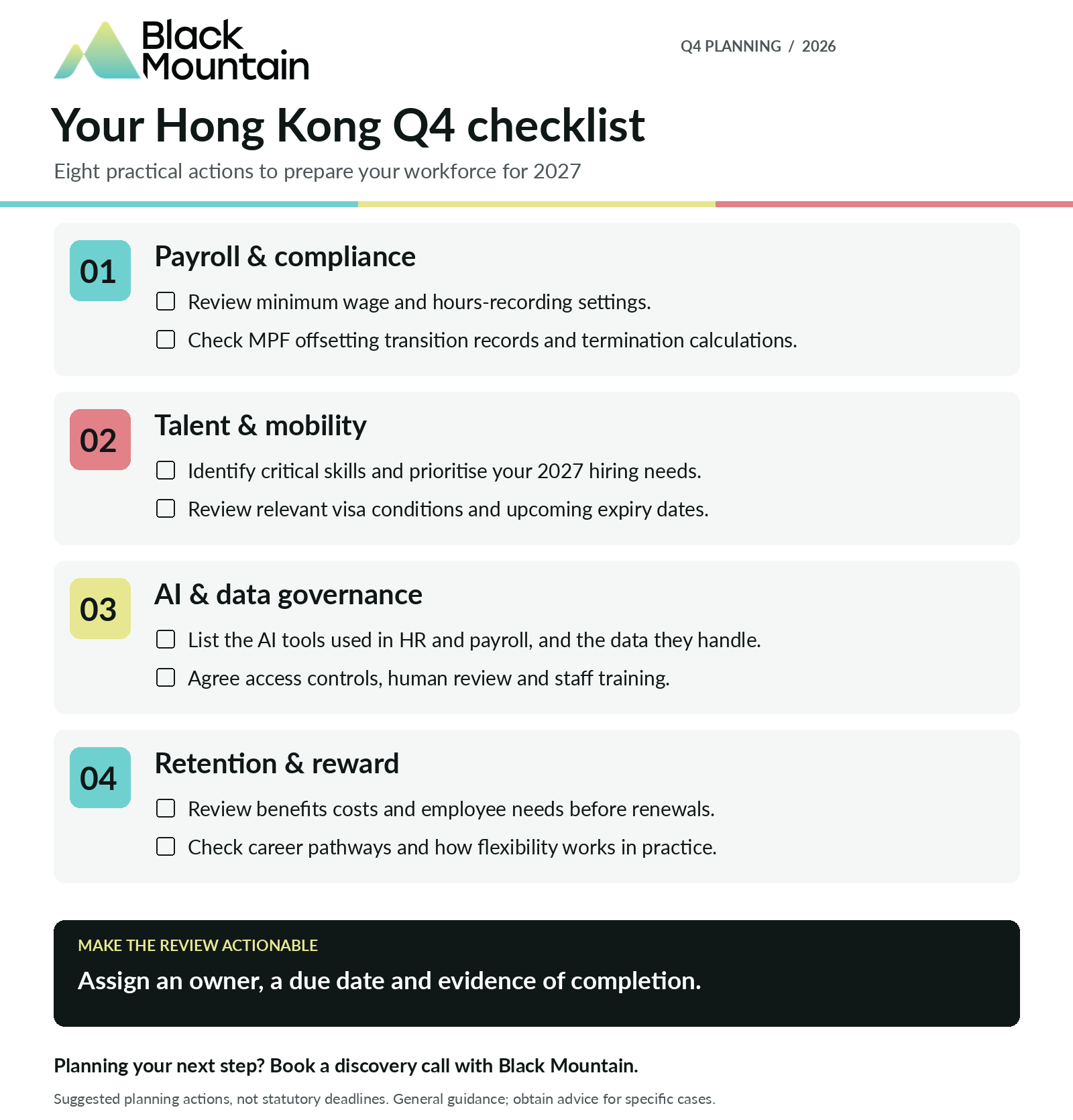
Use the last quarter of the year to prepare for the January reset:
-
Compliance and payroll
-
Confirm all in-scope roles are paid at or above HK$43.1 per hour and that hours-recording processes reflect the HK$17,600 monthly threshold (Labour Department).
-
Verify severance and long service payment provisioning treats pre- and post-1 May 2025 service periods separately, and that the subsidy claim workflow is embedded in terminations (Labour Department Subsidy Scheme).
-
Refresh MPF employer voluntary contribution policies in light of the new offsetting rules.
-
-
Talent and mobility
-
Review 2027 workforce plans against the current hiring caution documented in KPMG’s outlook, and prioritise revenue-generating roles.
-
Map specialist skill gaps to TTPS categories where relevant, and prepare visa strategies in parallel with hiring plans (Immigration Department).
-
-
AI and operating model
-
Audit AI use cases already live inside HR and payroll processes, and document the data flows, vendor list, and PDPO position.
-
Set a minimum AI literacy standard for HR, finance and people-manager roles.
-
-
Retention and reward
-
Rebalance benefits ahead of 2027 renewals, with particular attention to medical inflation.
-
Make career pathways visible, and address the flexibility gap between policy and practice.
-
Frequently asked questions
When was MPF offsetting abolished in Hong Kong?
The MPF offsetting arrangement was abolished on 1 May 2025. From that date, employers can no longer use their mandatory MPF contributions to offset severance payments or long service payments accrued for post-transition service. The government’s 25-year Subsidy Scheme shares part of the cost with employers (Labour Department Subsidy Scheme).
What is the Hong Kong statutory minimum wage in 2026?
The Statutory Minimum Wage is HK$43.1 per hour with effect from 1 May 2026, and the monthly monetary cap for the hours-recording obligation is HK$17,600 per month (Labour Department).
Is Hong Kong’s job market growing in 2026?
It is cautious. Only 19% of employers expect headcount growth and 22% expect decreases, with hiring focused on sales and revenue roles (KPMG).
What is the Top Talent Pass Scheme (TTPS)?
The TTPS is a Hong Kong talent-attraction scheme with three categories. Category A applicants (annual income HK$2.5 million or above) receive an initial 36-month stay; Categories B and C receive 24 months. Applicants do not need a job offer to apply (Immigration Department).
Talk to Black Mountain about your Hong Kong workforce
Black Mountain has supported employers in Hong Kong for more than two decades, combining local payroll, HR, benefits and Employer of Record expertise with a global service network. If you would like a confidential conversation about your Q4 priorities, upcoming reforms, or plans for 2027, book a discovery call with our Hong Kong team.