
Germany HR and Payroll Trends 2026
Germany HR & Payroll Trends 2026

The German employer agenda in 2026
Germany is defined by a mix of hard cost pressure and structural transformation. The teams we work with are running lean, integrating AI into everyday HR work, and preparing for a step change in statutory pay and social security thresholds, all while the skilled worker shortage keeps a firm ceiling over how quickly they can hire.
Here is what is on the agenda when international businesses talk to us about their German workforce.
The statutory minimum wage rose to €13.90 per hour on 1 January 2026, with a further step to €14.60 already legislated for 2027. – Source
Social security contribution ceilings jumped in 2026, with the general pension ceiling rising to €8,450 per month (€101,400 per year) and the health / long-term care ceiling to €5,812;50 per month (€69,750 per year) Source
Employers must ensure a system is in place to record daily working time, including overtime, following the 2022 Bundesarbeitsgericht ruling that still shapes the legal position today. Source
Cost pressure and AI are the two biggest forces on the People strategy, cited by 57% and 55% of HR leaders respectively in the DGFP/Gallup State of HR in Deutschland 2026 study.
81% of HR professionals use AI daily or several times a week, primarily in recruiting, learning and workforce administration. Source
If you employ people in Germany, or are considering doing so, this is the year to make sure your payroll operating model can absorb the statutory changes without drama, and your HR agenda is set up to answer the questions your leadership is actually asking.
Cost pressure is the loudest signal in German HR
The DGFP and Gallup State of HR in Deutschland 2026 study, based on 312 HR specialists and managers surveyed in early 2026, is unambiguous. 57% of HR leaders say cost reduction or margin pressure is shaping their People strategy, ahead of accelerated digitalisation and AI development at 55%. Business model transformation and shifts in customer demand come next, at 35% each.
The consequence for HR agendas is a very concrete one. Rather than large-scale culture or engagement programmes, HR leaders are prioritising performance management, upskilling and organisational capability, the levers that promise the quickest measurable return. Yet 75% of the same HR leaders are dissatisfied with how performance management is currently working in their organisation, and only 3% are fully satisfied.
For international businesses running a German entity, the message is that your local HR partner or in-house team is likely to be under significant pressure to justify every discretionary budget line. The organisations getting the most out of this environment are those that:
- treat performance management as an everyday leadership behaviour, not an annual form,
- invest in AI enablement early so productivity gains are captured, not just promised, and
- protect the parts of the employee experience, flexibility, development and purpose, that show up in retention data.
Statutory pay: the €13.90 minimum wage and what it triggers
The German statutory minimum wage rose to €13.90 gross per clock hour on 1 January 2026, an 8.42% increase on the €12.82 rate that applied through 2025. The Fünfte Mindestlohnanpassungsverordnung has already legislated the next step to €14.60 per hour from 1 January 2027, a further 5.04% increase.
Two practical points for employers:
- The Mindestlohn floor is a floor, not a wage. Collective agreements, sector-specific minima and the tightening labour market often push the real market rate significantly higher. Rerunning benchmarking after both 2026 and 2027 steps is a sensible discipline.
- Mini-Jobs and low-hours workers need particular care. The Mindestlohn increase drags on the Mini-Job earnings threshold and can quickly turn a compliant Mini-Job into a normal employment relationship if the working-hours planning is not updated.
If your business relies on shift-based, seasonal or part-time labour in Germany, this is the point in the year to run a full-payroll audit against the new rate and against the already-legislated 2027 step, so that budgets and shift plans do not need to be reopened in twelve months’ time.
Social security ceilings: bigger jumps than usual
The 2026 uplift to Germany’s Beitragsbemessungsgrenzen was substantial. The key monthly and annual limits, effective 1 January 2026 (Bundesregierung):
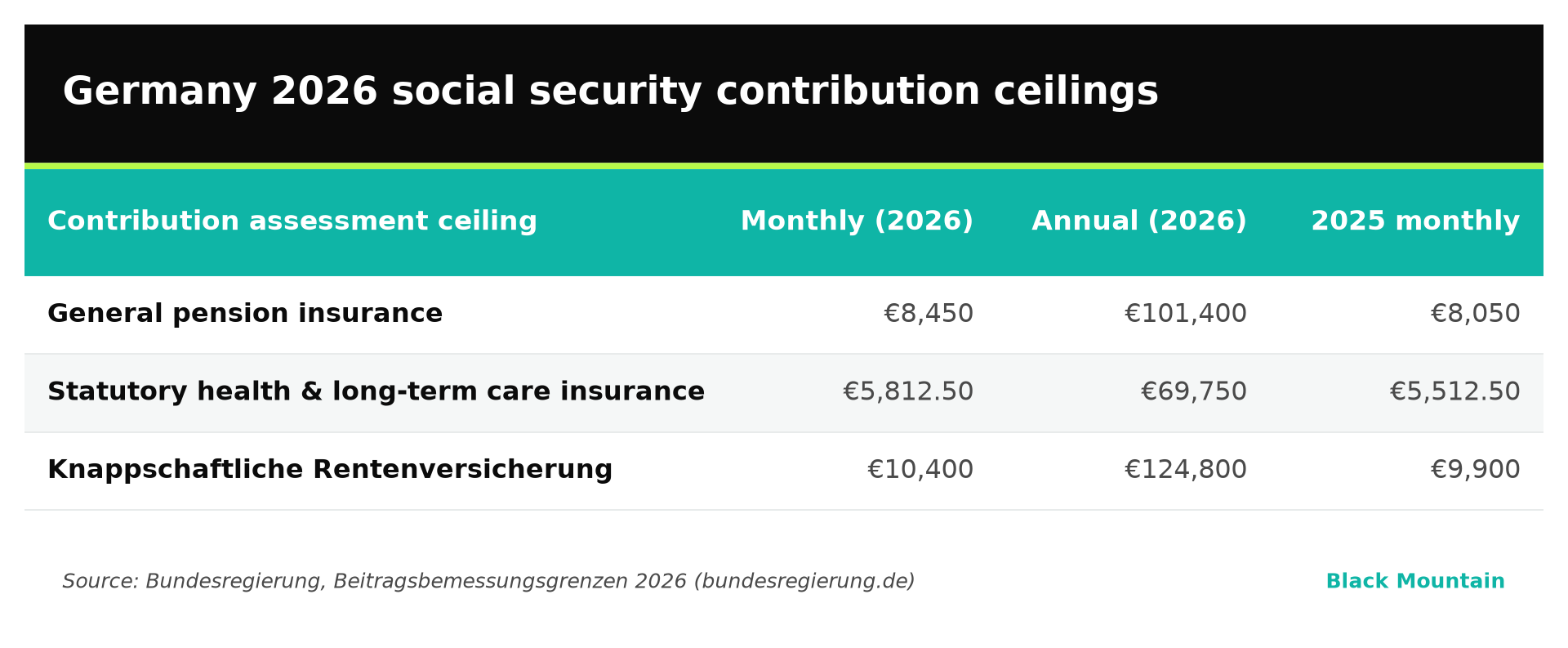
The preliminary average earnings figure used in pension calculations is €51,944 for 2026, up from €50,493 in 2025 (Bundesregierung).
What that means in practice:
- For higher earners above the ceilings, employer contributions in 2026 are meaningfully higher than in 2025.
- Total employment cost modelling, the fully loaded number an international CFO needs when comparing markets, needs to be rerun with the new figures. The gap between headline salary and total cost has widened.
- Payroll and HRIS system updates should already be complete; if a January regression check has not been done, Q4 is the moment to make sure the new figures are actually calculating correctly on real payslips.
Working time recording: the obligation is already in force
The German position on Arbeitszeiterfassung continues to be a source of confusion for international employers, so it is worth being blunt. The Bundesarbeitsgericht ruling of 13 September 2022 (1 ABR 22/21) established that employers are required under Section 3(2) of the Arbeitsschutzgesetz to introduce and use a system that records the start and end of each employee’s daily working time, including overtime (IHK Rhein-Neckar).
Key features of the current legal position:
No specific technology is mandated. Electronic and written systems are both acceptable, provided they capture start, end and break times, not just totals.
The obligation applies to all employees within the scope of Section 5(1) BetrVG, subject to the exceptions Germany has legislated under the Working Time Directive.
There is not yet a direct administrative fine for non-compliance with the recording obligation, but the competent authority can order specific measures, and downstream risks (working time violations, wage-and-hour disputes) can escalate quickly (IHK Rhein-Neckar).
The specific text of an updated Arbeitszeitgesetz that codifies electronic recording has been under discussion for some time, but the practical position for employers has not waited for it. If your German workforce is still on manual timesheets or informal recording, that is a compliance gap today, not next year.
AI in HR: everyday tools, uneven readiness
The DGFP/Gallup 2026 study shows how quickly AI has embedded itself into German HR practice. 81% of HR professionals and managers now use AI daily or several times a week. Usage is concentrated in the process-heavy, standardisable parts of the function:
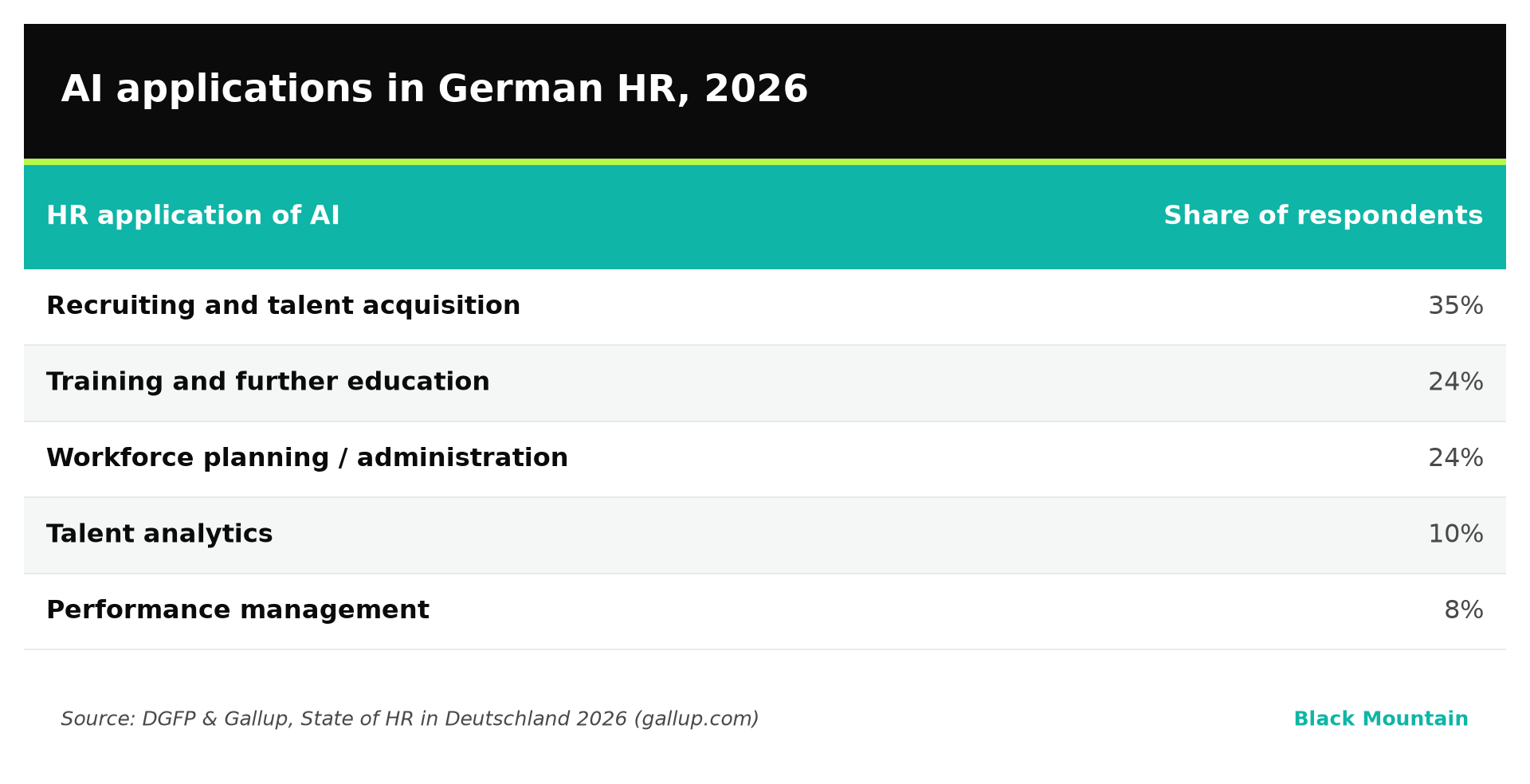
The striking counterpoint is readiness. Only 4% of respondents consider their employees fully prepared for the integration of AI technologies (DGFP/Gallup). The productivity opportunity is real, but so is the enablement gap.
For employers, three moves stand out for the rest of 2026:
1. Set a binding minimum AI literacy standard for HR, payroll and people managers, and treat it as part of role expectations.
2. Document the AI use cases already live inside HR, and check them against GDPR, works council co-determination obligations and the EU AI Act’s risk classification.
3. Direct the productivity dividend into higher-value HR work, proactive talent conversations, workforce planning, better performance coaching, rather than letting it evaporate into “we are all busier”.
The Fachkräftemangel is still the ceiling on growth
Germany’s skilled worker shortage remains one of the biggest constraints on business growth. It is why employers of choice cannot rely on brand alone to attract talent, and why hiring lead times in many technical roles run considerably longer than in comparable markets.
The pattern we see repeatedly with clients:
- Roles in engineering, tax, payroll, IT and skilled trades stay open longer, and cost more to close, than any other category.
- Employer branding does most of the heavy lifting before applications are received, not during the interview process.
- International hiring via the Fachkräfteeinwanderungsgesetz (Skilled Immigration Act) is more workable than many international HR leaders assume, but the paperwork and lead times need to be planned for.
Combined with the DGFP/Gallup finding that employee expectations around flexibility, meaning and development shape 31% of HR strategies, the takeaway is that the German talent market rewards employers who are visibly good at development, not just competitive on pay.
What our clients say
“We have partnered with Black Mountain for nearly a decade. The team assigned to us brings deep expertise and consistently delivers reliable, high-quality work. What sets them apart is their proactive approach, offering thoughtful advice and sharing best practices that help us stay ahead. It feels less like working with a vendor and more like having trusted colleagues who genuinely care about our success.” – Herwani, Schroders
Germany HR & Payroll Q4 2026 checklist for employers
- Payroll and compliance
- Confirm all in-scope employees are paid at or above €13.90 per hour and that Mini-Job hours plans are updated to remain under the earnings threshold ( Mindestlohn-Kommission).
- Update employment cost models with the new social security ceilings (€8,450/month pension, €5,812.50/month health) (Bundesregierung).
- Verify a compliant working time recording system is in use for every in-scope employee (IHK Rhein-Neckar).
- HR strategy
- Refresh performance management practice, given DGFP/Gallup’s finding that 75% of HR leaders are dissatisfied with the current approach.
- Define the AI literacy standard for HR and people managers, and document HR AI use cases against GDPR and the EU AI Act.
- Talent and workforce planning
- Rebuild 2027 workforce plans on the assumption that Fachkräftemangel constraints in engineering, tax, payroll and IT will persist.
- Prepare skilled-immigration paperwork for known 2027 hires now, rather than after the offer is signed.
Frequently asked questions
What is Germany’s minimum wage in 2026?
Germany’s statutory minimum wage is €13.90 gross per hour, effective from 1 January 2026. A further increase to €14.60 per hour is already legislated for 1 January 2027 ( Mindestlohn-Kommission, Euroref).
What are the German social security contribution ceilings in 2026?
The general pension insurance ceiling is €8,450 per month (€101,400 per year), and the statutory health and long-term care insurance ceiling is €5,812.50 per month (€69,750 per year) (Bundesregierung).
Do German employers have to record working hours?
Yes. Following the Bundesarbeitsgericht ruling of 13 September 2022, employers must ensure a system is in place to record the start, end and break times of each employee’s daily working time, including overtime. Electronic and written systems are both acceptable (IHK Rhein-Neckar).
How widespread is AI in German HR?
DGFP/Gallup’s 2026 study reports that 81% of HR professionals and managers use AI daily or several times a week, primarily for recruiting, learning, and administrative tasks. Only 4% consider their employees fully prepared for AI integration.
Talk to Black Mountain about your Germany workforce
Black Mountain supports international employers in Germany with local payroll expertise, HR advisory, and Employer of Record services, backed by a global service network. If you would like a straightforward conversation about your 2027 planning, statutory changes, or workforce strategy in Germany, book a discovery call with our team.
📞 – +44(0)1432 272787
🖥️ – www.blackmountainhr.com/contact
📩 – enquiries@blackmountainhr.com