
EU Pay Transparency: A Practical Guide for Employers
Introduction
The EU Pay Transparency Directive represents one of the most significant employment and reward reforms in a generation. By mid-2026, organisations operating across Europe will face new obligations around pay disclosure, reporting, and accountability.
About this guide
This eBook is designed to help organisations:
- Understand what the EU Pay Transparency rules mean in practice
- Prepare HR, Payroll, and reward functions for compliance
- Anticipate employee and candidate expectations
- Position pay transparency as a strategic advantage, not just a regulatory burden
Executive Summary
By June 2026, all EU Member States must implement national legislation aligned with the EU Pay Transparency Directive. The Directive aims to reduce the gender pay gap by increasing transparency, strengthening employee rights, and placing accountability on employers.
For employers, this means:
- Salary transparency becoming the norm at hiring stage
- Employees will gain formal rights to pay information
- Mandatory gender pay gap reporting will apply to many organisations
- A higher compliance and litigation risk if unjustified gaps exist
For employees, this means:
- Greater visibility into how pay is set
- Stronger tools to challenge unequal pay
- Increased confidence in fair and objective reward practices
Organisations that prepare early will be better positioned to manage risk, build trust, and strengthen their employer brand.
Why Pay Transparency is Changing in Europe
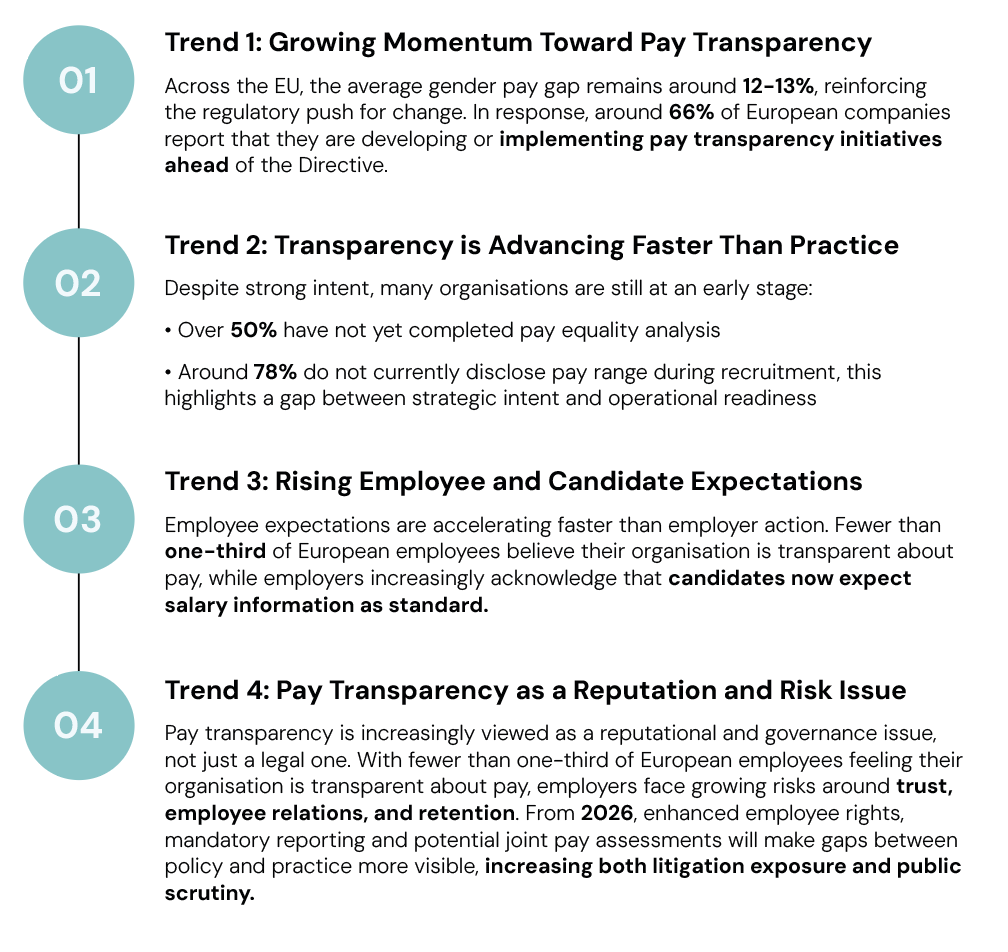
Across the EU, women earn on average around 12-13% less than men. While many organisations have taken steps to address pay equality, progress has been uneven across countries and sectors.
Pay practices
Historically, pay practices in Europe have often been opaque:
- Salary ranges were rarely disclosed in job ads
- Employees had limited insight into how pay decisions were made
- Enforcement of equal pay rules relied heavily on individuals bringing claims
The EU Pay Transparency Directive was introduced to address these structural issues by embedding transparency into everyday employment practices.
Policy Objectives
The directive seeks to:
- Prevent pay discrimination before it occurs
- Make unequal pay visible and measurable
- Strengthen enforcement of equal pay principles
- Shift the burden of proof from employees to employers
Overview of the EU Pay Transparency Directive
The EU Pay Transparency Directive builds on long-standing EU principles of equal pay for equal work, or work of equal value, which have existed in EU law for decades. Despite this, enforcement has historically been weak due to lack of transparency, limited access to information, and the burden placed on individuals to prove discrimination.
The Directive introduces a harmonised framework across Member States to close these enforcement gaps. While national implementation will vary, the core obligations are binding and represent a minimum standard that all countries must meet.
Key Date and Timelines
- Directive adopted at EU level: 2023
- National transposition deadline: 7th June 2026
- First reporting reference periods: 2026 data year
- First mandatory reports published: 2027 (depending on employer size)
This means that although reporting obligations may not be due until 2027, the pay structures and decisions made in 2026 will already fall within scope.
Scope of Application
The Directive applies broadly to:
- All employers in EU Member States, public and private
- All employees, including part-time and fixed-term workers
- Recruitment processes for roles based in the EU, even if hiring is managed from outside the EU
Importantly, multinational employers will need to ensure consistency across countries while managing local legal variations.
Pay Transparency at the Recruitment Stage
Recruitment is one of the most visible and impactful areas of change under the Directive. For many organisations, this will represent a significant cultural shift.
- Mandatory Salary Disclosure
- Employers must provide candidates with the defined salary range, or the starting salary for the role, either in the job advert or before the first interview, ensuring transparency from the outset.
- Gender-Neutral Job Adverts
- Job titles, descriptions and selection criteria must be gender-neutral and objectively justified. This requires employers to review language, role expectations and evaluations criteria.
- Prohibition on Salary History Questions
- Employers may not ask candidates about their previous or current salary. This includes indirect attempts to obtain salary history. This rule aims to prevent historical inequalities from following employees throughout their careers.
- Timing of Disclosure
- Salary information must be provided in the job advertisement, or at the latest, before the first interview. This effectively eliminates late-stage surprises and forces organisations to define pay parameters up front.
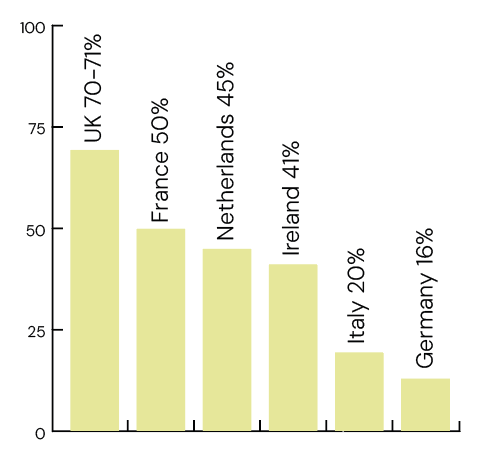
Salary disclosure differ widely across major European markets
Practical Impact
For employers, this means:
• Establishing clear pay bands before roles are advertised
• Reducing reliance on ad-hoc negotiation
• Training recruiters and hiring managers on compliant practices
Employee Rights to Pay Information
The Directive significantly expands employee access to pay information, increasing transparency during employment rather than only at entry or exit points.
Individual Right to Information
Employees will be entitled to request:
• Their own pay level
• The average pay levels of colleagues performing the same work or work of an equal value, broken down by gender
This information must be provided in a clear, accessible manner within a reasonable timeframe defined by national law.
Transparency of Pay-Setting Criteria
Employers must be able to explain how pay levels are determined, how progression and increases are decided, and which objective criteria’s are used (e.g. skills, responsibility, performance). Vague or discretionary explanations will no longer be sufficient.
Organisational Readiness
To respond confidently to employee requests, organisations will need documented job evaluation frameworks, consistent pay decision processes, and manager training to handle pay conversations constructively.
Gender Pay Gap Reporting Obligations
Mandatory reporting is a central enforcement mechanism of the Directive and will bring pay equality data into the public domain for many employers.
Employer Size Thresholds
Reporting frequency is determined by workforce size:
- 250 or more employees: annual reporting
- 150 – 249 employees: reporting every three years
- 100 – 149 employees: phased-in reporting at a later stage
Smaller employers may still face obligations under national law.
Required Data Points
Reports must include, at a minimum:
- Average gender pay gap
- Median gender pay gap
- Gender pay gap in variable pay and bonuses
- Distribution of male and female employees across pay quartiles
Joint Pay Assessments
Where a gender pay gap of 5% or more exists and cannot be objectively justified, employers must:
- Conduct a joint pay assessment with employee representatives
- Identify root causes
- Implement corrective measures within a defined timeframe
This process is designed to drive real change rather than passive reporting.
What This Means for Employers in Practice
Employers should begin reviewing pay structures, job architecture and HR and payroll data readiness to prepare for EU pay transparency, supported by our integrated European HR, Payroll, and Benefits services.
HR and Reward Functions
Key priorities include:
- Conducting comprehensive pay equality audits
- Reviewing job architecture and grading structures
- Aligning pay policies across countries and business units
Payroll and HRIS Teams
Systems must be capable of:
- Producing accurate, gender-disaggregated pay data
- Supporting recurring reporting cycles
- Maintaining audit trails for pay decisions
Legal and Compliance
Legal teams should:
- Track national implementation laws
- Review contracts, policies, and dispute procedures
- Advise on risk mitigation strategies
Leadership and Change Management
Senior leaders will play a critical role in:
- Setting the tone on transparency
- Supporting managers through change
- Communicating clearly with employees
Enforcement, Risk, and Penalties
The Directive strengthens enforcement mechanisms and increases legal exposure for employers that fail to comply.
Shift in Burden of Proof
In equal pay claims, employers will need to prove that pay differences are justified by objective, gender-neutral criteria. This represents a foundational shift in litigation risk, placing great accountability on organisations.
Penalties for Employers
Member States must introduce penalties that are effective and dissuasive. These may include:
- Financial fines
- Public naming or disclosure
- Mandatory corrective action plans
Reputational risk will be a significant factor, particularly for consumer-facing brands.
Remedies for Employees
Employees who experience pay discrimination may be entitled to:
- Full compensation
- Back pay and bonuses
- Interest on unpaid amounts
Mitigate Risk
With increased scrutiny and penalties from 2026, organisations must act now. Black Mountain can help assess pay structures and HR/Payroll data to ensure compliance with equal pay requirements confidently.
Key Trends Companies Are Experiencing
As the deadlines approach, several clear trends are emerging across European organisations as they prepare for pay transparency.
Lead With Transparency
From 2026, EU rules will require organisations to be open about pay, provide employees with information, and report on gender pay gaps. Acting early reduces risk and builds trust with employees and candidates.
Why Act Now
• Fewer than one-third of employees feel their employer is transparent about pay
• Waiting until the deadline increases risk of fines, litigation, and reputational damage
• Transparent pay practices attract and retain top talent
Next Steps
1. Review pay structure: align grades, ranges, and bonuses
2. Audit payroll & HR data: fix gaps and inconsistencies
3. Train managers: ensure fair, confident pay conversations
4. Prepare for reporting: implement a governance to meet EU obligations
Make transparency a strategic advantage with Black Mountain.
Black Mountain can help organisations embed transparent pay practices across Europe, ensuring compliance and building trust with employees and candidates.
📩 – enquiries@blackmountainhr.com
📞 International – +44 (0)1432 272787