
Singapore Payroll Made Simple: CPF, Payslips and Deadlines
Singapore Payroll Made Simple: CPF, Payslips and Deadlines
Running payroll in Singapore means more than paying salaries on time. Employers calculate CPF contributions by age band, pay the Skills Development Levy, issue itemised payslips and report employee income to IRAS each year. CPF rates for senior workers also rise on 1 January 2027, so payroll settings need checking before the January run.
This blog sets out the rules, rates and deadlines in plain English.
Key facts at a glance
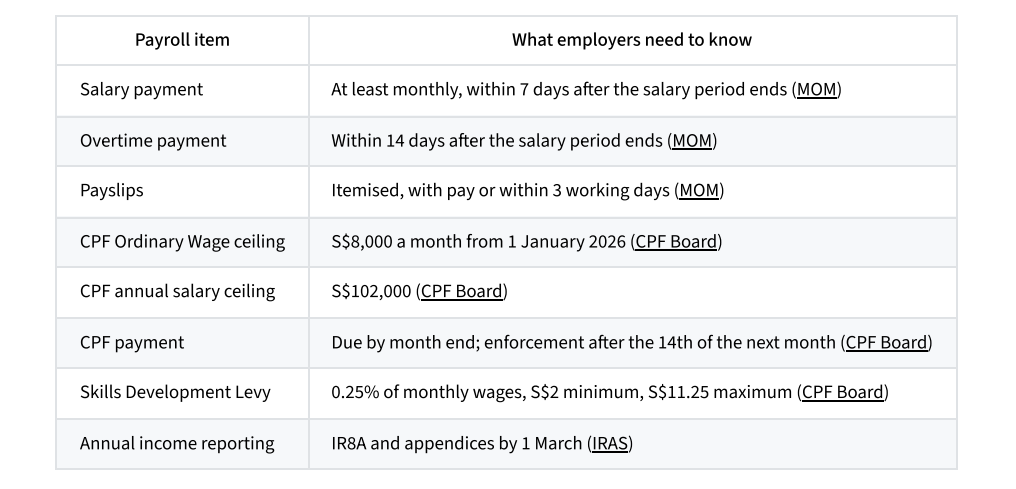
How does payroll work in Singapore?
Singapore payroll is the monthly process of paying employees, deducting and paying CPF for Singapore Citizens and Permanent Residents, paying the Skills Development Levy, and deducting any Self-Help Group contributions. Unlike the UK, Singapore has no monthly pay-asyou-earn income tax. Instead, employers report annual earnings to IRAS, and employees pay their own tax. A typical monthly cycle looks like this:
- Collect hours, overtime, leave, allowances and bonuses.
- Calculate gross pay, separating Ordinary Wages from Additional Wages.
- Work out employer and employee CPF by age band and wage level.
- Deduct Self-Help Group contributions where they apply.
- Calculate the Skills Development Levy for every employee. Singapore Payroll Made Simple: CPF, Payslips and Deadlines Key facts at a glance How does payroll work in Singapore?
- Pay salaries and issue itemised payslips.
- Submit and pay CPF, SDL and Self-Help Group contributions to the CPF Board.
What are the CPF contribution rates for 2026 and 2027?
CPF (Central Provident Fund) is Singapore’s mandatory savings scheme. Employers and employees both contribute for Singapore Citizens and Permanent Residents. For monthly wages above S$750, the total rate is 37% for employees aged 55 and below. From 1 January 2027, rates rise for employees aged above 55 to 65.
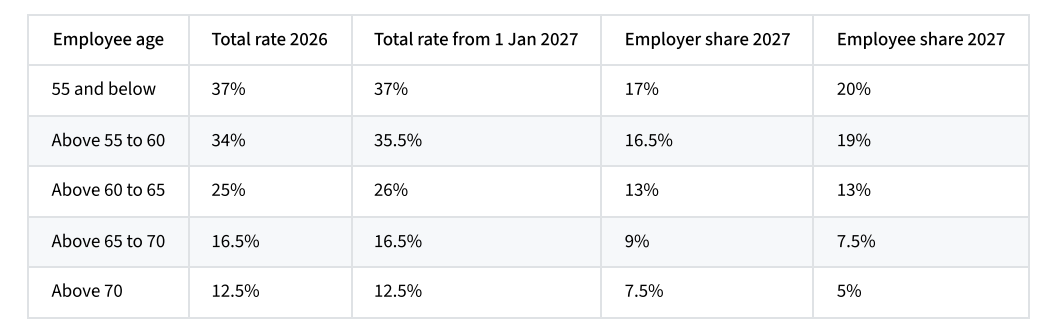
To soften the cost, the government will give employers a CPF Transition Offset of 0.25 percentage points of wages for employees in the two affected age bands in 2027.
How do the CPF wage ceilings work?
CPF is only payable on Ordinary Wages up to S$8,000 a month. Total wages that attract CPF are capped at S$102,000 a year, which limits CPF on bonuses and other Additional Wages. For example, an employee aged 40 earning S$10,000 a month pays CPF on S$8,000 only. That gives an employer share of S$1,360 and an employee share of S$1,600 each month.
When does a CPF rate change take effect for an employee?
The new age-band rate applies from the first day of the month after the employee’s birthday. For example, someone who turns 55 in January moves to the above-55 rates for wages earned in February. Payroll systems need accurate dates of birth to get this right.
When must CPF be paid?
CPF contributions are due on the last day of the month the wages relate to. The CPF Board takes enforcement action if payment has not been made by the 14th of the following month. Late payment interest of 1.5% a month runs from the day after the due date. In practice, building a payment date before the 14th into your payroll calendar avoids penalties and keeps employee CPF statements up to date.
What is the Skills Development Levy?
The Skills Development Levy (SDL) is an employer-only charge that funds workforce training. It applies to all employees, including foreign employees. It is 0.25% of each employee’s monthly total wages, with a minimum of S$2 for employees earning under S$800 and a maximum of S$11.25 for those earning over S$4,500.
SDL is not deducted from employee pay. It is paid to the CPF Board alongside CPF contributions.
What are Self-Help Group contributions?
Self-Help Groups (SHGs) support lower-income households in Singapore’s Chinese, Eurasian, Muslim and Indian communities. Employers are expected to deduct SHG contributions from employees’ wages and can pay them to the CPF Board together with CPF.
The four funds are:
- CDAC (Chinese Development Assistance Council)
- ECF (Eurasian Community Fund)
- MBMF (Mosque Building and Mendaki Fund)
- SINDA (Singapore Indian Development Association)
Contribution amounts depend on monthly wages, and employees can opt out by applying to the relevant group.
What must a Singapore payslip include?
Employers must give itemised payslips to all employees covered by the Employment Act. Payslips can be paper or electronic. They must be issued with the salary payment, or within three working days of it.
Where applicable, a payslip must show:
- employer and employee full names
- date of payment and the salary period
- basic salary (or hourly, daily or piece rate and units worked)
- fixed and one-off allowances
- other payments such as bonuses, rest day pay and public holiday pay
- deductions, including employee CPF
- overtime hours, overtime pay and the overtime period
- net salary paid
Salary records must be kept for the latest two years for current employees, and for one year after an employee leaves.
Who is entitled to overtime pay in Singapore?
Overtime pay is compulsory for non-workmen earning a monthly basic salary of S$2,600 or less, and for workmen earning S$4,500 or less. These employees fall under Part 4 of the Employment Act. Overtime must be paid at no less than 1.5 times the hourly basic rate, and within 14 days after the end of the salary period.
How is employee income reported to IRAs?
Each year, employers must prepare Form IR8A and, where relevant, Appendix 8A (benefits in kind) or Appendix 8B (share gains) by 1 March for the previous calendar year. Employers covered by the Auto-Inclusion Scheme (AIS) must submit this information electronically by the same date.
Getting this right matters because IRAS uses the data to pre-fill employees’ tax returns.
What are the income tax rates in Singapore?
Tax-resident individuals pay progressive rates, from 0% on the first S$20,000 of chargeable income up to a top rate of 24%. Non-residents pay the higher of a flat 15% or the resident rates on employment income.
What is tax clearance (Form IR21)?
When a non-Singapore Citizen employee stops working for you, is posted overseas or leaves Singapore for more than three months, you must usually file Form IR21 with IRAS at least one month in advance. You must also withhold all money due to the employee from the date you become aware of their departure.
This applies to all work pass holders and to Permanent Residents. Late or missed filing can lead to a fine of up to S$5,000. It is one of the most commonly missed steps for international employers.
Singapore payroll calendar (deadlines)
Salary payment is due within 7 days after salary period ends
Itemised payslips need to be sent with pay or within 3 working days
Overtime payment needs to be paid within 14 days after salary period ends
CPF, SDL and SHG contributions due on the last day of the month
CPF enforcement begins if unpaid on the 14th of the following month
Form IR21 for non-citizen leavers at least 1 month before departure
IR8A and appendices, or AIS submission with a hard deadline 1 March each year
New CPF rates for employees aged above 55 to 65 with a deadline of 1 January 2027
Common Singapore payroll mistakes
- Using last year’s CPF table after a rate change, especially in January.
- Missing an employee’s move into a new age band the month after their birthday.
- Applying CPF to foreign employees who are not Permanent Residents.
- Forgetting that SDL applies to foreign employees too.
- Leaving out required items on payslips, such as overtime hours.
- Paying a departing foreign employee in full before filing Form IR21.

How Black Mountain can help
Black Mountain manages payroll for employers in Singapore and internationally, covering CPF, SDL, payslips, IR8A reporting and tax clearance. Whether you are hiring your first employee in Singapore or bringing several countries together, our team keeps your payroll accurate and on time.
📞 – +65 6050 2595
🖥️ – www.blackmountainhr.com/contact/
📩 – enquiries@blackmountainhr.com
Frequently asked questions
Do employers pay CPF for foreign employees?
No. CPF applies to Singapore Citizens and Permanent Residents. However, employers must still pay the Skills Development Levy for foreign employees.
What is the CPF Ordinary Wage ceiling in 2026?
The CPF Ordinary Wage ceiling is S$8,000 a month from 1 January 2026. The annual salary ceiling stays at S$102,000.
What CPF rates change in January 2027?
From 1 January 2027, the total CPF rate rises to 35.5% for employees aged above 55 to 60, and to 26% for those aged above 60 to 65. Rates for other age groups are unchanged.
Do Singapore employers deduct income tax from salaries?
Not usually. Singapore has no monthly PAYE system. Employers report annual earnings to IRAS through the IR8A or Auto-Inclusion Scheme, and employees pay their own tax.
How quickly must a salary be paid in Singapore?
Salaries must be paid at least once a month and within 7 days after the end of the salary period. Overtime must be paid within 14 days.
What happens if CPF is paid late?
Late payment interest of 1.5% a month applies from the day after the due date. Enforcement action is taken if payment is noy made by the 14th of the following month.